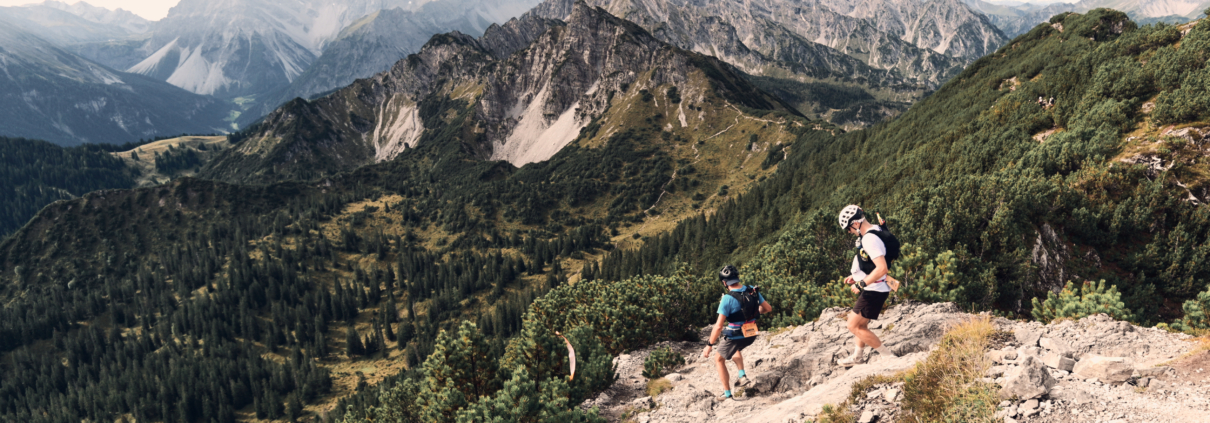
It is a moment of deceptive euphoria: After a grueling, hours-long uphill, you finally reach the pass. Your heart rate settles, the view opens up, and a fatal thought forms in your mind: “The worst is over. Now I just let it roll.”
It is a widespread misconception in ultra-running that stage races are won on the uphills. We torture ourselves for hours grinding up steep ramps in training, optimize our cardiovascular efficiency at the aerobic threshold, and obsessively fine-tune our power-hiking cadence. But the naked, biomechanical reality on the trails of Graubünden is unforgiving: The true battle of a multi-stage race is fought on the downhill.
Anyone who blindly surrenders to gravity on the descent and relies on supposedly “saving energy” is signing their athletic death warrant for the very next stage. Why? The exact answer lies in cellular biomechanics.
The Trauma of Eccentric Contractions
Unlike running on the flat or uphill, where your muscles work primarily concentrically (shortening), running downhill demands extreme eccentric work. Your thigh muscles (specifically the quadriceps femoris) act as massive shock absorbers. They are forced to lengthen under maximum tension to absorb the heavy impact of your body weight and gravity with every single step.
This immense mechanical braking load leads to microscopic tears at the cellular level. In sports science, we call this Exercise-Induced Muscle Damage (EIMD). During this process, the ultrastructural links in your muscle cells—the delicate Z-discs—are literally torn apart.
The Causal Chain of Destruction:
- Extreme mechanical braking load on the downhill.
- Massive stress on the cellular Z-discs
- Muscular trauma (EIMD).
- Total collapse of Joint Stiffness.
The direct consequence of this trauma is devastating: Your musculoskeletal system loses its natural, elastic spring. On Day 2, not only does every step feel like running through thick concrete, but your body also burns significantly more oxygen and glycogen for the exact same pace. Why? Because the passive energy return from your tendons and muscles has completely collapsed.
The Topographical Reality: The Descent into the Rhine Gorge
At this year’s Transalpine Run and the RUN2, this biomechanical law won’t be tested eventually—it will be tested immediately.
Stage 1 features the relentless alpine loop around Lenzerheide. The long, highly technical final descent back into the valley acts as a brutal tenderizer for your muscle fibers.
Stage 2 then delivers the killing blow: On the way to Ilanz lies the notorious, steep descent into the monumental Rhine Gorge. Anyone who has already mechanically destroyed their quads through overconfidence the day before in Lenzerheide will break on this downhill. You won’t be able to run it; you will be forced to endure a painful, stiff hike—the most certain path to a premature DNF via time cut-offs.
The RUN2: Your 48-Hour Real-World Lab
This is exactly why the RUN2 is not just a “short” TAR. It is the ultimate sports science real-world laboratory. It encompasses these exact first two brutal downhill stages, including the decisive descent into the Rhine Gorge.
You don’t have to risk your health for an entire week to find out if your downhill mechanics are race-ready. The RUN2 offers you the elite opportunity to validate your eccentric load tolerance under unforgiving conditions at true race pace, gathering priceless data for your future trail performance.
Your Preparation Starts Now:
On Thursday, July 30th at 5pm CEST, we are going deep into the engine room in our second exclusive Live Session: “The Multi-Stage Multiplier – Downhill Destruction in Numbers.”
We will calculate the real eccentric braking load of the Rhine Gorge section and use hard data to show you exactly how to adjust your cadence to actively protect your muscles from destruction.

