
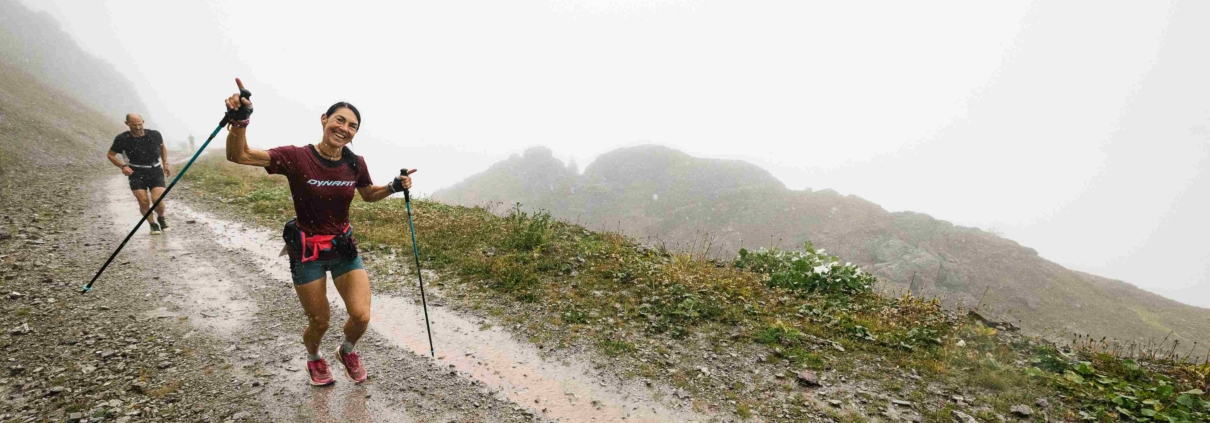
Anyone preparing for this year’s Transalpine Run or the RUN2 by simply adding up distances and elevation gain is walking blindly into a trap. A classic single-stage ultra is predictable: you run until you’re empty, you finish, and you recover. A stage race is an entirely different beast. I learned this the hard way in 2014 at the 10th anniversary of the TAR: Extreme weather, deep snow on the passes, valley heat, and relentless route changes tore even the closest teams apart.
A multi-stage race is a ruthless chain of incomplete recovery cycles. You start every single morning with pre-damaged muscle fibers and a nervous system operating at its limit.
The Principle of Allostatic Load
To prevent a premature Did Not Finish (DNF), we must understand the principle of Allostatic Load. It is the sum of all stress factors—from the mechanical destruction of your quads and permanent thermoregulation to a collapsing gastrointestinal tract—hitting you simultaneously.
The absolute critical phase, the “System Shock,” happens exactly in the first 48 hours. This is where it is decided whether your body adapts or your system collapses.
The RUN2: The 48-Hour Real-World Lab
This is exactly where the invaluable strategic worth of the RUN2 lies. The 2026 course takes no prisoners: Day 1 is a relentless alpine loop around Lenzerheide. Day 2 forces you down extremely technical descents into the Rhine Gorge all the way to Ilanz.
You cannot validate a high-alpine system on a treadmill or in your local hills. The RUN2 is your elite, sports-science real-world laboratory. If you want to verify your pacing strategy, your eccentric muscle tolerance, and your gut integrity under the compounded allostatic load of the Alps, you must master these first 48 hours in Graubünden. It is not a warm-up—it is the ultimate litmus test for any ambitious trail runner.
Your Roadmap for Preparation
We are breaking the causal chains of failure right now. On Thursday, July 23, we launch our exclusive STEFAN HELBIG x TAR Live Session: “The Anti-DNF Framework – Pacing & Data Science on the Mountain.” I will scientifically dissect the Lenzerheide course for you. We will use hard metrics (Grade Adjusted Pace and Heart Rate Decoupling) to identify your personal risk profile and adapt your Day 1 pace based purely on data.
Ready for alpine reality?
